Indigenous Diggers
Section 1: Boer War
Background
The story of Aboriginal Diggers starts with the Boer War. There were other wars the colonies had been involved (NZ, Egypt, and China) but not recorded as having Aboriginal diggers. Outside the scout hall in Mt Morgan, Queensland is a large bell. This bell weighs over 500 kg and was made from pennies collected by the school children of Mount Morgan. The bell celebrates the victory in a far away South African town called Mafeking. The town was under siege by the Boers and was being held by a British army commander – Colonel Baden-Powell. Baden-Powell is the person who later started the Scouting Association worldwide.
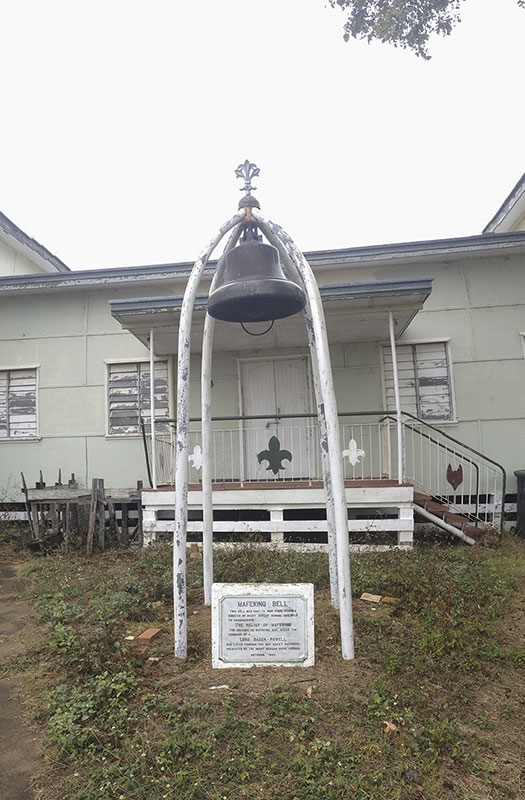
Across Australia in many towns you will find stone and concrete memorials to the local soldiers who fought in the Boer War. Investigate your local area for memorials of this war.
Aboriginal people were no different to the rest of the population. The call for help from Britain was a rallying cry to all of Australia. The love of Australia and doing the right thing meant Aboriginal men wanted to go to war. Australia was not a nation in 1899. Australia was a group of British colonies. NSW, Victoria, Queensland, Western Australia and South Australia. When the Boer War finished in 1902 – Australia had become a nation.
Why Was There a War in South Africa?
The Boer War 1899-1902 was fought in the country we now call South Africa. The African colony was originally formed by the Dutch in the 17th Century. The war was between Britain and the northern province people called the Boers. The Boers were mainly from Holland.
The Boers spoke a language which is called Afrikaans which comes from the Dutch language of the Netherlands. Britain’s interest in control grew when diamonds and gold were discovered in the Northern States of the Transvaal. The states of the Transvaal were controlled by the Boers.
The British through a series of battles and wars got control of the southern part of the colony. This was to be called Cape Colony and was a colony of the British. Many Boers moved from the British rule to the north. The north was controlled by the Boers who held the states of Transvaal and Natal.
The British were determined to control the colony and conflict was going to happen as a result. The British used the excuse of mistreatment of British-speaking peoples in the Northern provinces to take action.
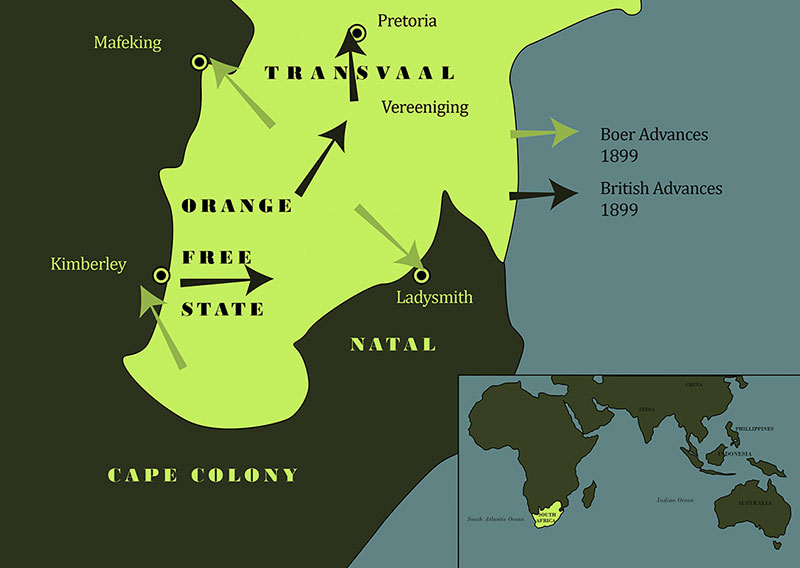
The gold and diamonds were providing a great source of wealth in the Orange Free State. (See Figure 1.2) The wealth the Boers obtained from the diamonds and gold allowed weapons to be purchased from Germany and to build an army to fight the British.
Australia was a group of colonies of Britain at the start of the war in 1899. The British made a request to the Australian colonies to send troops to Southern Africa. Each colony sent troops and by the time of their return, Australia had become a nation.
Counter-insurgency!
It was a rebellion where the enemy was not prepared to fight in a style which was suitable to the British. The British were quickly in a position of losing the war due to the Boer style of warfare which was surprise attacks and then vanish. The Boers were mounted soldiers with swift movement.
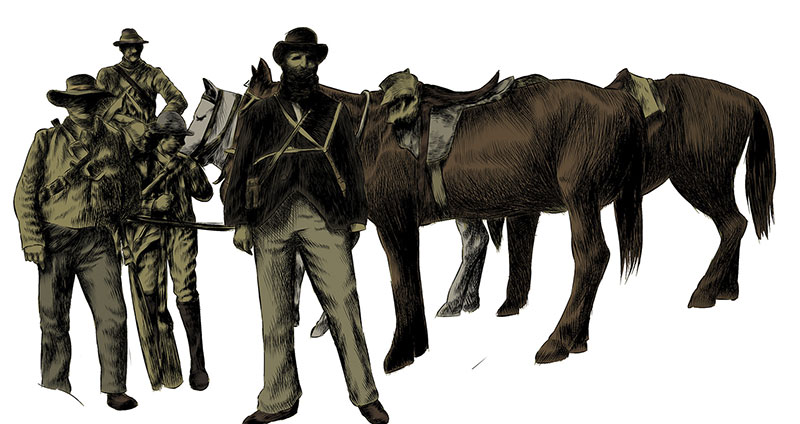
The British were prepared for battlegrounds and armies facing each other while the Boers fought what we call today, a guerrilla campaign of ambush and disruptions. The British required mounted troops who would be able to battle in the conditions of the Transvaal. This was called a ‘counterinsurgency’ of hunting down the bands of small groups of Boer soldiers. The British formed what was to be called ‘Bushmen’ units which were young men from the country areas of NSW, Queensland, Victoria, Tasmania, South Australia and Western Australia. They were capable horse riders, able to use rifles and move over the country with ease! Many of these Bushmen units sent from the colonies contained Aboriginal men that had been trained as mounted police and trackers. These men were able to quickly handle the harsh and dry conditions of Southern Africa as it was similar to inland Australia.
The athletic ability and bush skills of Australian aboriginals made them ideally suited to be soldiers. Over 50 aboriginal black trackers were sent to Southern Africa to fight the Boers.
Aboriginal Bushmen were used in tracking the insurgents and also searching for missing soldiers. They were very effective at finding the Boer soldiers in the bush. There is very little information in historical records but many aboriginal families state that a relative or great grandfather went to the Boer War.
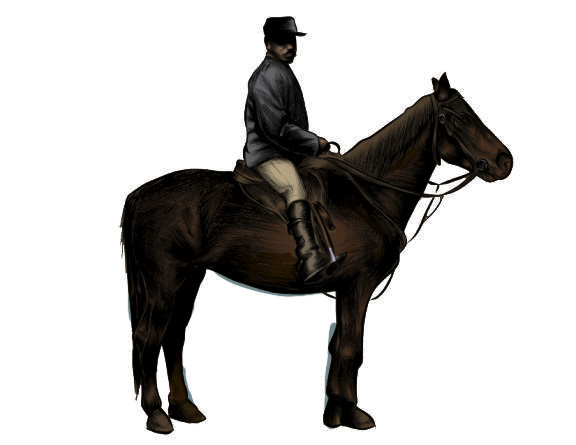
The number of actual Aboriginal mounted troopers is considered to be about 50 which is only a guess. The aboriginal trackers played a crucial role in the defeat of the Boer rebellion.
Bushmen Units
The Australians generally were very suited to this type of warfare. These were later to form the Light Horse units! The Light Horse units were used in the First World War.
Australia colonial units went into battle nearly immediately upon reaching South Africa. They moved north into the Orange Free State to break the siege of Kimberley which was a success (see map). From Kimberley they were involved in numerous small scale skirmishes until they broke the siege of Mafeking (see map) and went on to capture the main town of Pretoria.
To know more about this war and the involvement of Australians in general, view the Australian movie ‘Breaker Morant’ which deals with the control and treatment of Australians by the English officers. Go to your local war memorial and see if there is a plaque or remembrance item for the Boer War.
The Boers were skilled countrymen too who had excellent rifles. The Boer soldiers could stage ambushes and then disappear. It was the job of the counter insurgency soldiers to track the Boer soldiers and defeat them. Aboriginal trackers were able to quickly find the Boer soldiers and defeat them.
Weapons
The major weapon was the rifle (spinning bullet) which was very accurate and fired a bullet similar to the modern day’s rifle. They were very accurate over a long range and also killed with one shot due to the size of the bullet. These Mauser rifles used by the Boers were deadly on the British.
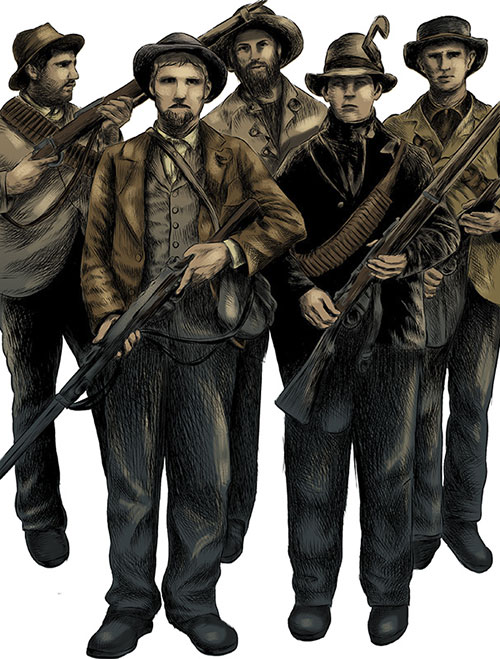
The Boers had the Mauser (Germany) rifle while the British and Australians had the Enfield (United Kingdom). The Mauser rifle was considered a more accurate rifle than the Enfield rifle.
Machine guns
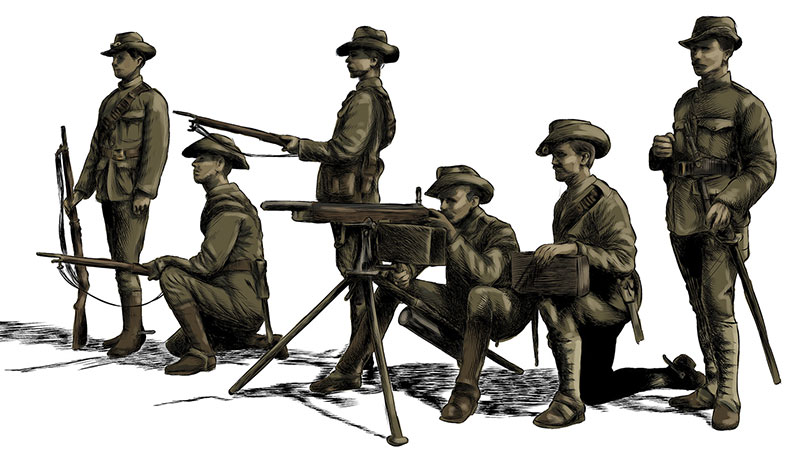
Both sides also used machine guns which were belt fed bullets. These machine guns fired about 50 bullets a minute. They could fire over a large area very quickly.
It needed up to five men to fire and feed the machine gun.
The success in the campaigns against the Boer armies meant that the British and Imperial Forces captured all the towns in the Transvaal and Natal states. The towns were controlled by the British forces but not the countryside where the guerrilla warfare continued. It was impossible to hold all of the surrounding countryside so this meant that pockets of insurgents could continue to fight the British and Australian troops. In response to this continual fighting, the British forces implemented, in many places, a scorched earth approach where women and children were rounded up and held in concentration camps. The farms and livestock were destroyed so that it did not provide any help to the Boer insurgents. It is estimated that over 20,000 children died in these concentration camps due to illness and starvation.
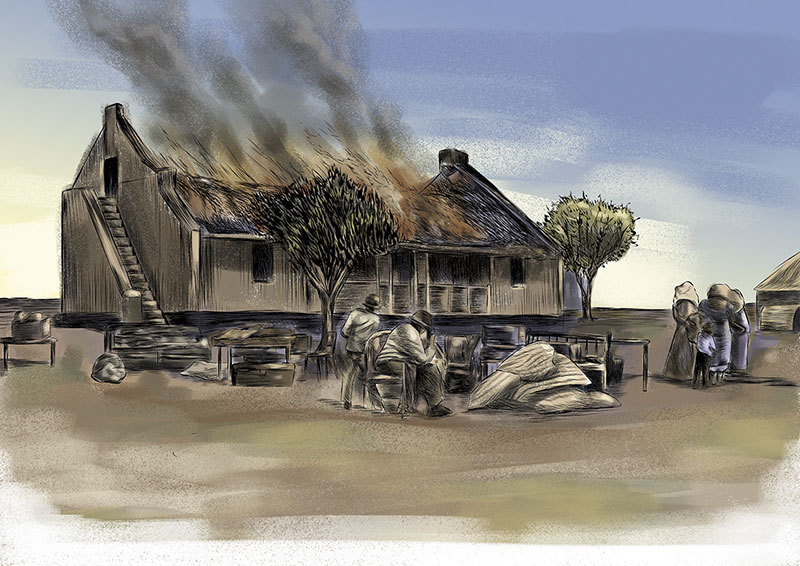
Public opinion in Australia, NZ and Great Britain turned against the War as they realised the suffering and death of many innocent people. By 1903 the Boer representatives had surrendered and Southern Africa now became a British colony called, The Union of South Africa.
Aboriginal Soldiers Returning from the Boer War
Aboriginal people were left out of the new Federal Constitution which was the legal document for the process of forming a nation called Australia. It was based on the colonies of NSW, Victoria, South Australia, Tasmania, Western Australia and Queensland. It was to be a federation of states and made laws for purpose of defence and immigration controls across all states. Some powers would be Federal and others would remain with the States – the same applies today in regard to a division of responsibilities.
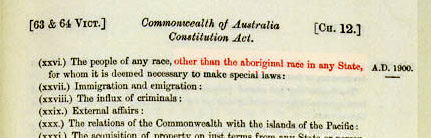
This meant in law that Aboriginal people had no means of getting laws changed nationally which would improve their position. Aborigines were simply protected under the law as part of states’ Native laws. In the case of the Boer War they served as black trackers and at war’s end were not entitled to return to the new nation of Australia as there were immigration controls on non-white peoples. It is believed that some were left in South Africa without any means of getting back to Australia. There are stories of people today in South Africa who believe their great grandfather was an Australian aborigine.
Aboriginal soldiers upon returning to Australia did not have the same rights as other soldiers. In some cases they were worse off as Aboriginal reserve lands were given to ex-soldiers as part of war service.
War’s End – Beginning of the Buildup to the Next
The end of the Boer War and Britain’s battles had increased the chances of war rather than ending this possibility. Germany had now realised that Britain and its empire were able to lose easily. The defeats suffered by the British in the Boer War showed that they could not beat a small rabble of Boer soldiers let alone a large, trained army such as Germany’s. The Boer War convinced German military leaders that they could go to war with Britain and win! So the Boer War ended and the pathway to World War 1 had begun.
Production of rifles, machine guns and ammunition was done in large factories and production could be easily increased. The scale of industrial production meant that the next war would have all the weapons needed to kill the other side. The Boer War lead directly to the start of World War 1 in Europe. Germany felt they had the means now to overpower both Britain and France.
Activities
Assessment
Download the assessment for this section.
Online assessment will be added in a future version.
Progress
Section not yet completed.