Indigenous Diggers
Section 5: Malaya Peninsula War
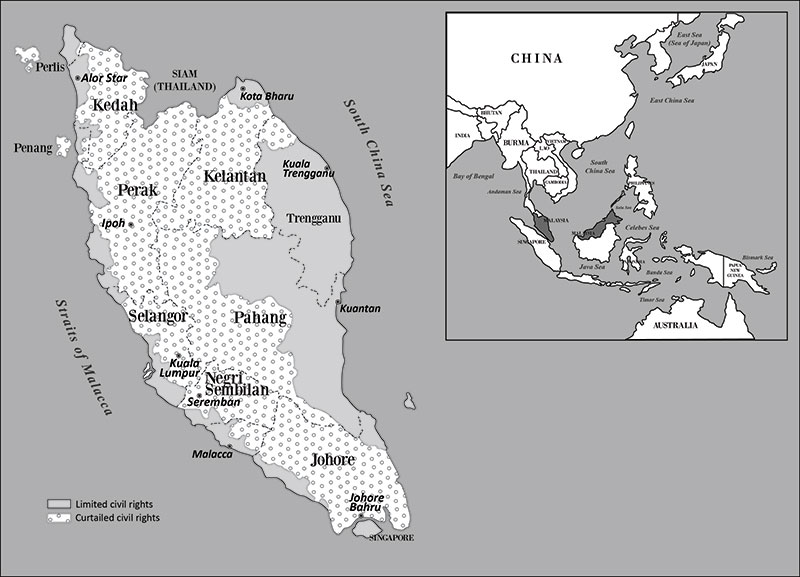
Malaya was a British colony up to 1957. The British fought a Communist Party insurgency. These groups had fought the Japanese and now wanted political involvement. Part of the Chinese population of Malaya felt left out of becoming Malayan citizens.
These highly trained and experienced jungle fighters were now fighting the British not the Japanese. They saw the British control of the rubber plantations, the industries and the political processes as unfair. The conditions were not good and after the war the situation was still grim.
The Malayan Emergency started in 1948 and lasted until 1960. As late as the 1970’s there were still people who actively supported the overthrow of the government to create a communist country.
Australia worked with the British in Malaya to isolate the Communist uprising. The plan was to move their base to the jungles where they no longer had village support and could not keep fighting being in the jungle. Australia sent aircraft and three regiments in rotation. Army medical specialists and support staff were also sent.
The involvement was a long period over 13 years. There was continuous patrolling, securing areas and building an air force base near Penang called Butterworth. This insurgency training was going to be quickly used again when the Vietnam War started with the involvement of America and its allies including Australia.
The war with the Chinese Malay communists lasted over 13 years. The Malayan Emergency was the longest military war in Australia’s history. Fifty-one Australian servicemen were killed in Malaya and 27 were wounded.
Indigenous soldiers served in the Malayan Emergency. It is believed that there were over 25 indigenous soldiers serving. For example, a military medal was awarded as well to one of the Indigenous soldiers.
Indonesian Confrontation
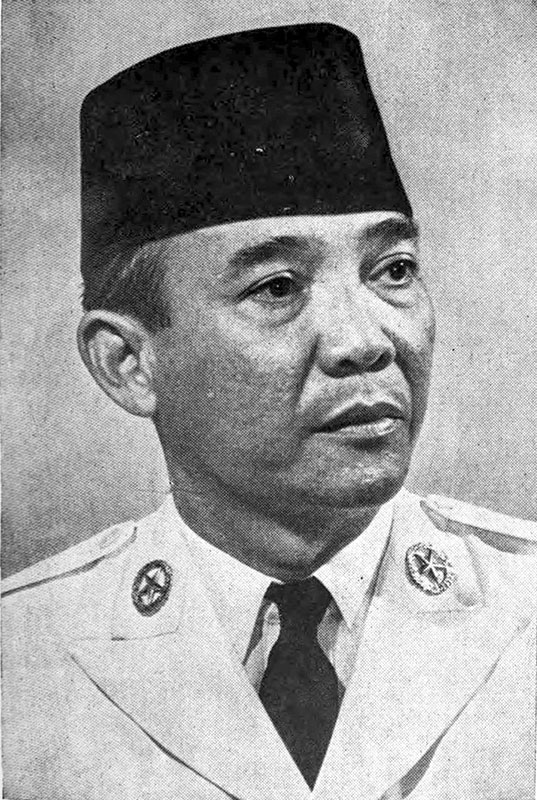
Between 1962 and 1966 Indonesia and Federation of Malaya fought a small, undeclared war which came to involve troops from Australia, New Zealand and Britain. The conflict resulted from a belief by Indonesia’s President Sukarno that the creation of the Federation of Malaysia, which became official in September 1963, represented an attempt by Britain to maintain colonial rule behind the cloak of independence granted to its former colonial countries in south-east Asia. The term ‘Confrontation’ was coined by Indonesia’s Foreign Minister, Dr Subandrio, in January 1963, and it has come to refer to Indonesia’s efforts at that time to upset the new federation of Malaysia. Indonesia wanted to break up the new country of Malaysia. The actual war began when Indonesia launched a series of cross-border raids into Malaysian territory in early 1963. These raids took place in Sarawak with the aim of gaining support from local villagers. This was not very successful!
Background
On 31 August 1957 the Federation of Malaya gained full independence, as a sovereign country, from the United Kingdom. The country was led by first Prime Minister Tunku Abdul Rahman and consisted of a series of states. Singapore was granted self-government by the United Kingdom in 1959.
On 16 September 1963 Malaya merged with Singapore and the British territories of Sabah and Sarawak, along the north and north-east of Borneo, to form a new federation known as Malaysia. This merger had been promoted 2 years earlier by the UK and Malaya with the support of Singapore. (Singapore subsequently left Malaysia on 9 August 1965 with both Malaysia and Singapore having decided that it was in neither country’s interests for Singapore to remain in the federation.)
The Commencement of Fighting
Although the Indonesian Government of President Sukarno had initially supported the concept of the new nation of Malaysia that support soon changed to being against. In December 1962 there was an attempted Indonesian-backed coup in the sultanate of Brunei which is located between Sarawak and Sabah. The coup was quickly quashed by British and Gurkha soldiers. From then onwards however armed incursions into northern Borneo continued from Indonesia and these incursions increasingly involved Indonesian soldiers. In January 1963 Indonesian declared ‘Confrontation’ (in Indonesian ‘Konfrontasi’) against the proposed new country Malaysia, even before the actual formation of Malaysia. Throughout 1963 raids from Indonesia into the Borneo states increased in number and intensity leading to fighting with British forces. In September 1964 there was a serious escalation when Indonesian forces attacked the southern peninsular Malaysian states.
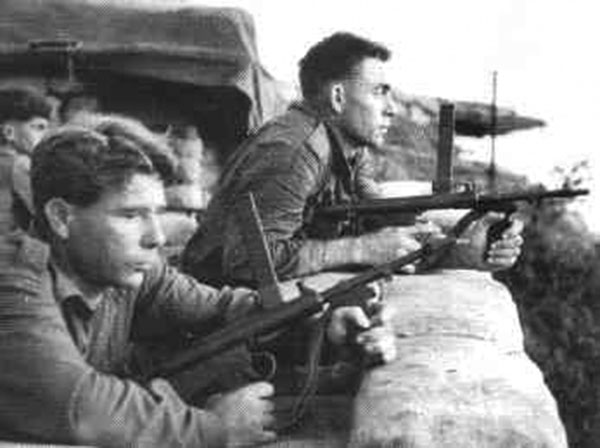
Australian military forces had been stationed in Malaya since mid-1950 to assist in the fight against communist guerrillas during what was known as the Malayan Emergency. After Malaysia came into being in September 1963, both Malaysia and Britain asked for Australian troops to be sent to Borneo to help repel Indonesian-backed incursions. The Australian Government did not respond immediately to these requests but, after further requests and Commonwealth talks held in March 1964, Australia agreed to supply Malaysia with stores and military equipment and to train Malaysian soldiers in both Australia and Malaysia. In April 1964 a squadron of Australian engineers was sent to Borneo and two Australian Navy minesweepers were made available to patrol the area.
Escalation
Following the September 1964 escalation of hostile activities by Indonesia Australian forces, along with forces from other British Commonwealth countries such as New Zealand, were called into action to deal with the incursions in the southern peninsular Malaysian states. Members of the 3rd Battalion, the Royal Australian Regiment (3RAR), assisted in operations against the invaders and in December 1964 the minesweeper HMAS Teal exchanged fire with an Indonesian vessel off Singapore.
In January 1965 the Australian Government agreed to the deployment of 3RAR to Borneo. 3RAR arrived in Borneo in March 1965 and relieved a Ghurkha unit at Bau in western Sarawak. The battalion remained in the area for four months, during which time it carried out patrolling and ambush operations on both sides of the border with Indonesia. Although the heaviest fighting of the battalion’s time in Borneo occurred in ambushes of Indonesian troops, the three Australian soldiers killed during this period were victims of mines laid by the Indonesians.
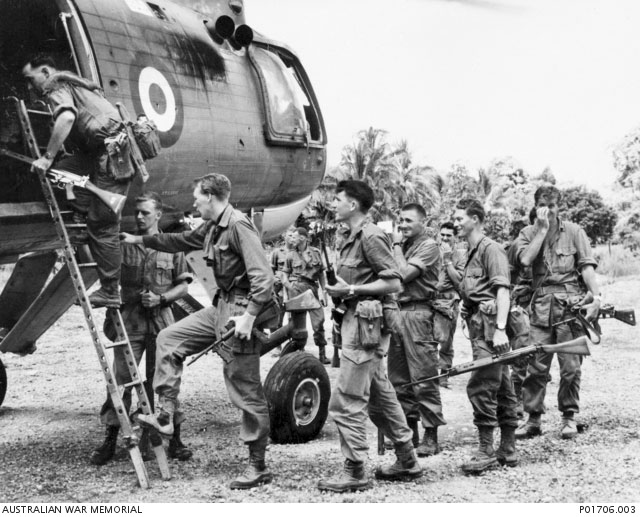
The 4th Battalion, the Royal Australian Regiment (4RAR) replaced 3RAR in the 28th Commonwealth Brigade and served in Sarawak between April and August 1966. Operating from fortified bases around Bau, the battalion carried out patrols on both sides of the border, some of which led to clashes with Indonesian soldiers. In addition to military operations, the battalion conducted a ‘hearts and minds’ campaign.
Australian SAS soldiers were used overseas for the first time during the Indonesian Confrontation. The 1st Squadron of the Australian SAS Regiment served in Borneo from February to August 1965. Three months of this period were spent on ‘claret’ operations. The squadron also conducted more conventional reconnaissance patrols and ‘hearts and minds’ operations. The 2nd Australian SAS Squadron operated in Borneo between February and July 1966, performing a range of tasks including ‘claret’ operations. Three members of the Australian SAS were killed in action in Borneo. Indigenous soldiers in the elite SAS included Corporal Ron Harris.
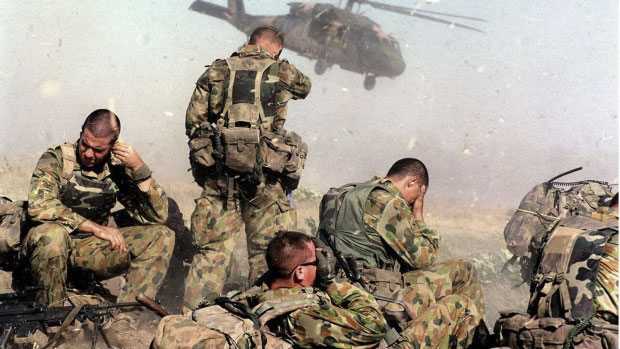
Royal Australian Air Force involvement included Hercules C130 flights carrying troops and supplies between Malaya and Borneo while Sabre jet fighters of No.78 Wing RAAF began deploying from Butterworth airbase to Labuan in Borneo in September 1965. 12 Royal Australian Navy vessels attached to the British Commonwealth Far East Strategic Reserve patrolled Malaysian waters at various stages during the conflict.
The Conclusion of Confrontation
By the end of 1965 the military situation in the Malaysian Borneo states had been stabilised. On 30 September and 1 October that year there was a failed coup attempt in Indonesia. President Sukarno quickly lost real power although he was not replaced as President until March 1967. The effective new leader, General Suharto, was not interested in pursuing Confrontation any further and a treaty between Indonesia and Malaysia was signed in Bangkok in August 1966.
Australian Casualties
Seven Australians died on active service in the Indonesian Confrontation.
Twenty-three Australians were killed during the Confrontation with Indonesia. Indigenous soldiers served in this campaign. The number of Indigenous soldiers in the Indonesia campaign is approximately 20.
Activities
Assessment
Download the assessment for this section.
Online assessment will be added in a future version.
Progress
Section not yet completed.