Indigenous Diggers
Section 4: Korean War
The end of the war in the Pacific left vacuum spaces in many parts of Asia. Japan had at once stage, controlled Vietnam (Indo China), Indonesia, Korea, Manchuria, Malaya, Burma and parts of the Pacific. This gave the local people a small taste of freedom before the colonial powers wanted to return. The spirit in most countries was to resist and fight for freedom from foreign masters. The end of World War 2 was to ripple for the next 50 years with many wars still to be fought.
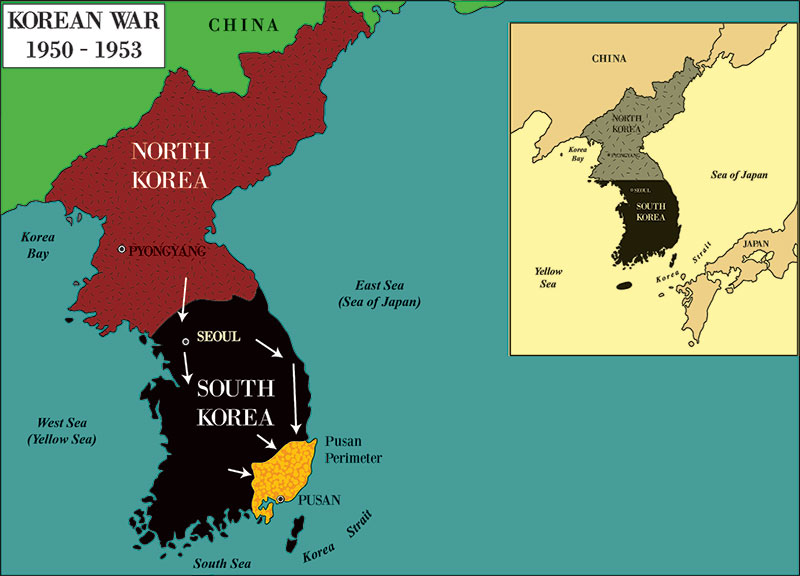
Korea was controlled by Japan during World War 2. The division of Korea after World War 2 led to the Korean War in 1950. The North was controlled by the Soviet Union and the South was controlled by the USA.
On the 25 June in 1950 the North Korean army crossed into South Korea. The major city of Seoul was captured within a week. The North Koreans marched south towards the port city of Pusan. The USA offered help to stop the invasion. The United Nations Security Council asked nations to help repel the North’s forces. Twenty-one nations including Australia sent soldiers plus armaments to stop the attack. China then entered the war on the side of North Korea.
Why? The crisis in Korea originated in the closing of World War II, when control of the Korean Peninsula, formerly a colony of Japan, was given to the Allies. The United States and the Soviet Union divided responsibility for the country between them at the 38th parallel. Both North and South Koreans wanted a unified Korea—no different to dividing Australia based on a straight line across the map.
On the 25 June 1950 the North Korean Army crossed into the southern area and marched towards the capital, Seoul. The city was over run in less than a week, and North Korean forces continued their southward drive towards the port city of Pusan. This was a surprise and a major international crisis as it had broken all the rules of division and control.
The US quickly offered air and sea support to South Korea. and the United Nations Security Council asked all its members to assist in stopping the North Korean attack. Twenty-one nations, including Australia, responded by providing troops, ships, aircraft and medical teams. The Chinese Army now became involved supporting North Korea. The United Nations forces including Australia finally found a balance again between North and South Korea where neither side could gain ground. The war was similar to a World War 1 trench warfare where each fought with artillery and mines and in set piece battles.
The first was the Battle of Kapyong, where Australians helped stall a major Chinese advance, at a cost of 32 men killed. The Chinese army lost over 2000 soldiers in this battle. Captain Reg Saunders an Indigenous officer was in charge of ‘C’ Company for the 3rd RAR who backed up and stopped the Chinese advance to Seoul. The 3rd RAR was awarded a US Presidential Unit Citation for bravery. Captain Reg Saunders was offered a bravery award but refused the offer.
The second major battle for the Australians was Operation Commando, where after five days of heavy fighting, the Chinese withdrew. Twenty Australians were killed in this battle.
In the three years of the Korean War. The USA lost 33,000 men. Nearly half a million South Koreans died as a result of the war, and an unknown number of North Koreans and Chinese possibly in the millions. Australian casualties and deaths numbered more than 1500, of whom 339 died. There were over 35 Indigenous soldiers went to the war in Korea – at least two soldiers were killed – S.K.J. Lenoy and T. Hazel. Many soldiers were not identified as indigenous so the actual figures are guessed.
North and South Korea still do not have a peace treaty. North Korea remains isolated from the rest of the world with a communist style government. It is run by a 33-year-old called Kim Jong-un. His father was the ruler of North Korea and he took over on his father’s death. North Korea is unstable as it is very poor and the people have little freedom. The rest of the world would like to help North Korea recover and feed its people but Kim Jong-un regards the rest of the world as enemies.
Activities
Assessment
Download the assessment for this section.
Online assessment will be added in a future version.
Progress
Section not yet completed.