Indigenous Studies
Section 2: Rock Paintings – Pictographs
There are many sites that are sacred to Indigenous Australians, with paintings on rock in caves, rock shelters, the sheltered side of boulders and under overhanging rocks.
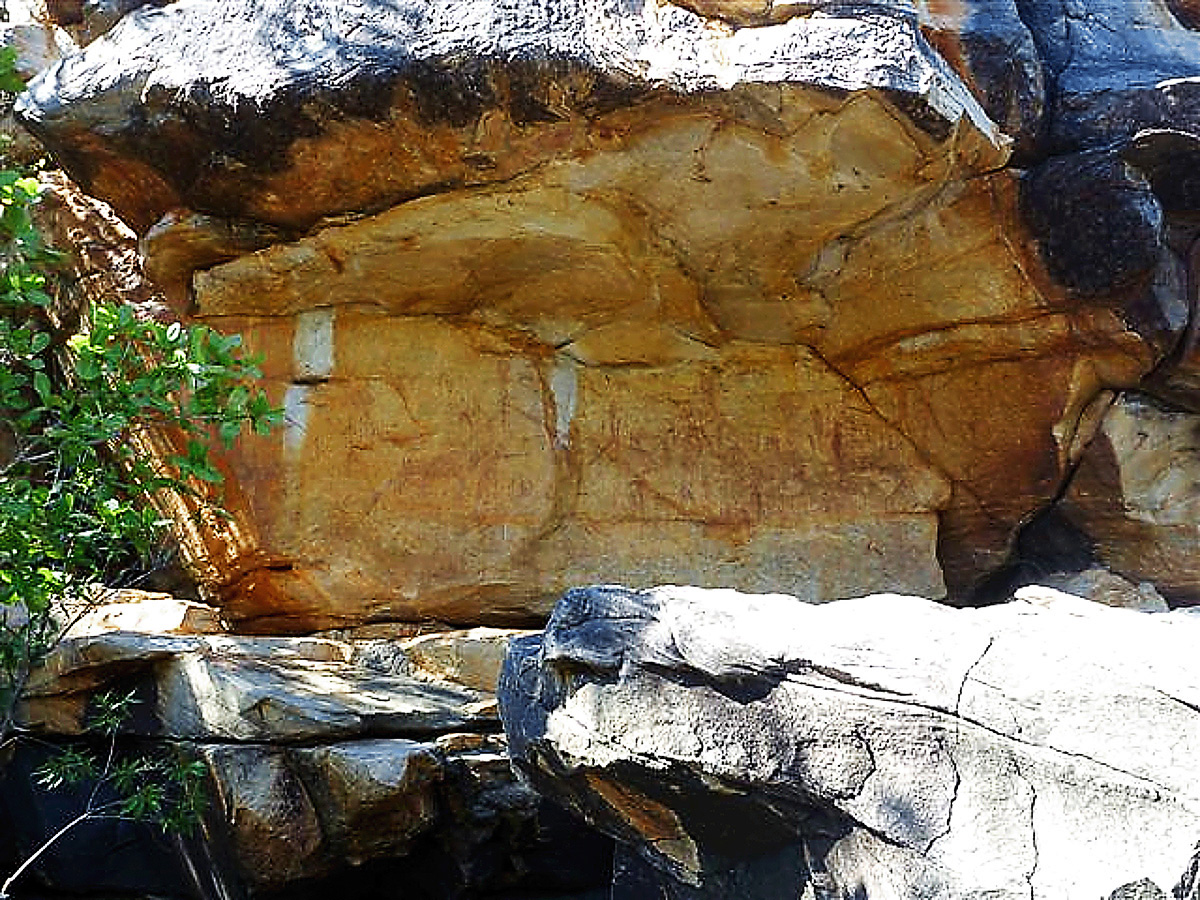
Art under overhanging rock, Mitchell Falls, Kimberley, WA.
The colours and types of paintings not only vary according to their age but also vary from place to place according to the local culture. There are variations in the symbols used in rock paintings, as they depend on the clan, tribe or region of Australia that the artists belong to.
Activity 2.1: Draft an explanation
Rock engravings are usually found on open, flat surfaces. On the other hand, rock art is usually found in protected places such as caves and under overhanging ledges. Draft a possible explanation for this difference.
As you obtain further information from the following pages, you may want to come back and edit or add to your explanation.
The Indigenous Artist’s Palette
Indigenous Australian people generally used just a few colours in their paintings. Some pigments were made from fine white clay, charcoal and animal blood as well as ochre that was mined from pits or quarries.
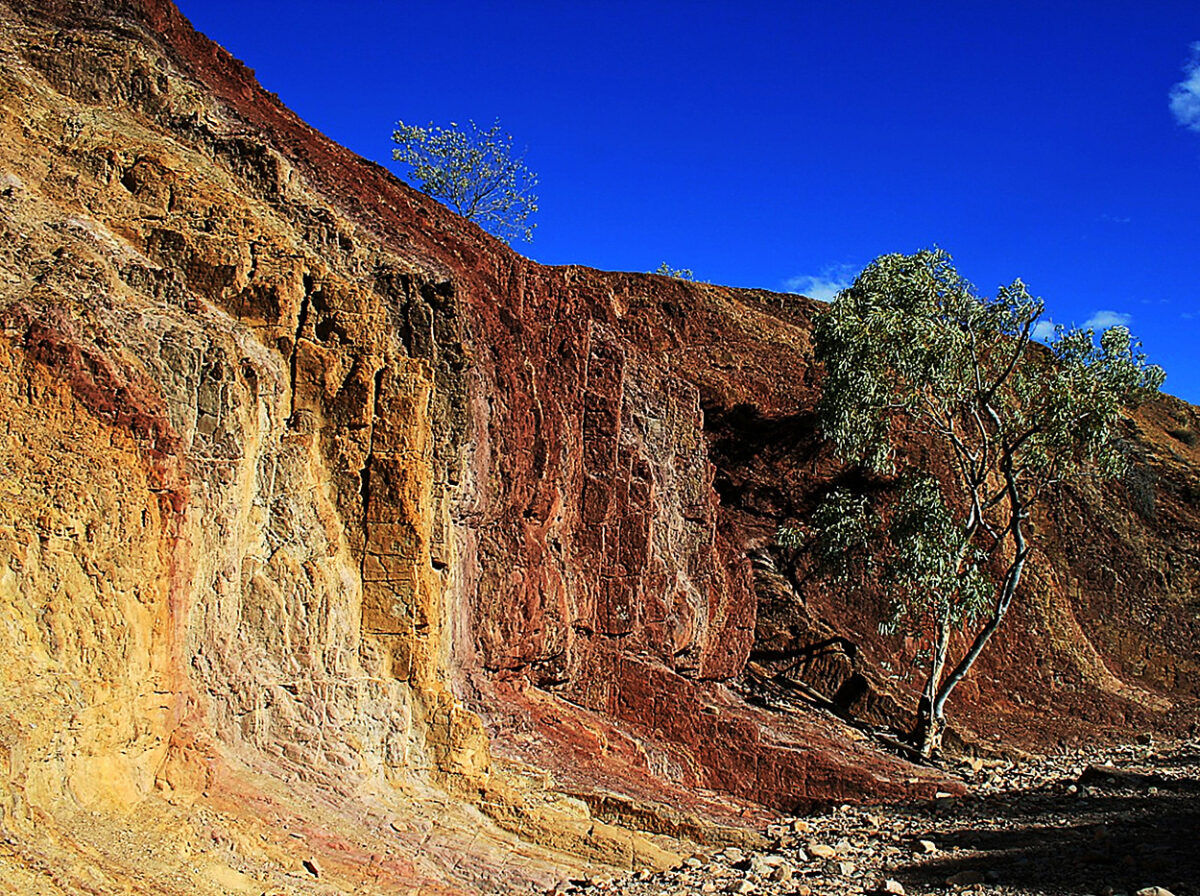
Ochre Pits in Central Australia where a variety of clay earth pigments were obtained.
Image source http://en.wikipedia.org/wiki/Indigenous_Australian_art#Rock_painting
Ochre from earth pigments produce paint in all least four different colours:
Yellow
Red
Purple
Brown
The ochre stone is ground to a powder and then dampened, usually with water but sometimes saliva or blood, or the fat of a fish, emu, possum or goanna is used.
Ochre was and still is important for Indigenous people as it is used in religious ceremonies, burial ceremonies and for body decorations, as well as for paintings and drawings. Over many thousands of years, Aboriginal communities established a complex web of trade routes all over Australia to share resources. Ochre was one such important resource that was traded between clans and at one time could only be collected by specific men within the clan.
Activity 2.2: Dictionary Practice
Some words have been underlined in the text above that you need to check for their meaning. Before you complete that activity in Table B, go through the text again and underline any other words that you want to check too. Write these words in Table A and use a dictionary to find the meaning of that word that best suits the sentence in which it is used.
Table A: My list of new words
Table B: Matching meanings
Each item in Column 1 has its meaning in column 2 but they are not matching at the moment. Use your dictionary to match each word or pair of words with its meaning.
Show your understanding
Rewrite the following sentence in different words to show that you understand what it is saying: Over many thousands of years, Aboriginal communities established a complex web of trade routes all over Australia to share resources.
Fixatives
A fixative is a protective coating used for preserving and sealing artwork. Artists throughout history have used some type of clear or transparent chemical to stop pastels, pencils, watercolours, charcoals and inks from wearing away, smearing or discolouring over time.
Fixatives were and still are of two types: A “workable” fixative that is applied as a drawing develops. It can be applied to layers that could smudge so that the artist could rework sections or add to those that may have been finished. This type of fixative could be erased if necessary. A “final” fixative that is applied when a drawing is finished. This type of fixatives protects the artwork by producing a lasting film over the whole drawing. It also stops the flaking or peeling of the paint.
Since the 1500s, if not before, in Europe, traditional fixatives were composed of weak solutions of natural resins or gums from plants, glue made from boiling fish bones and skin, beer, and casein made from milk. Over the centuries, many recipes were developed that involved a combination of resins, drying oils, and other ingredients, such as wax. Artists continue to search for the best chemicals to preserve their works without causing any damage.
Australian Indigenous artists also discovered ways in which to preserve their paintings. Traditionally, ochres were mixed with saliva or blood to bind them. Beeswax, honey, egg yolk, emu fat, and tree sap were also used as fixatives to help the paint stay on the object or surface. For example, in some parts of Australia, ochres were mixed with the sap or juice of plants such as orchids to bind the powder and preserve paintings on bark.
Activity 2.3: Comprehension and Further Research
What is the purpose of a fixative in art? __________________________________
What are the differences between a “workable” fixative and a “final” fixative_____________
List the natural ingredients used to make fixatives in past times in Europe.
______________________________________________________
How many of the ingredients listed in part c would also be available to Australian Indigenous artists? Explain your answer. ____________________________________________________________
Australian Indigenous artists used ingredients from their surroundings to preserve their paintings. What differences would you expect to find in the fixatives used by Indigenous artists across Australia? Explain your answer. ___________________________________________________________
Techniques for Art
Rock art includes both paintings and drawings.
To make a painting, the artist will
grindstone to make powdered pigment,
mix the powder with liquid
add a substance to fix the painting
apply the mixture with a brush or finger.
For example, a brush might be made from reeds, bark or even the tails of small animals.
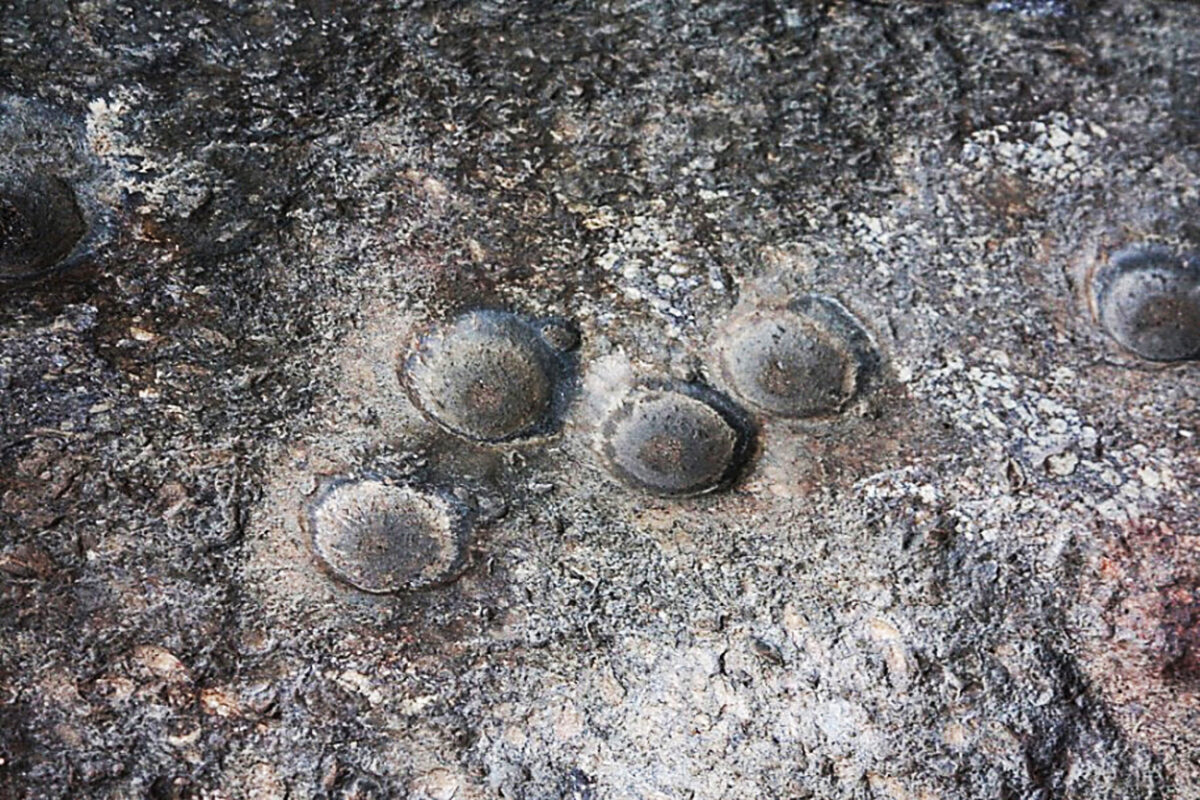
These bowls carved into the rock were used to mix paints. Burrunggui (Nourlangie Rock), Kakadu NP, Northern Territory.
Source: M. M. Watts.
To make a Drawing, the artist will
choose a coloured solid pigment that can be used to draw
rub the dry pigment against the rock surface.
For example, a piece of charcoal or ochre can be used to draw directly onto a rock surface.
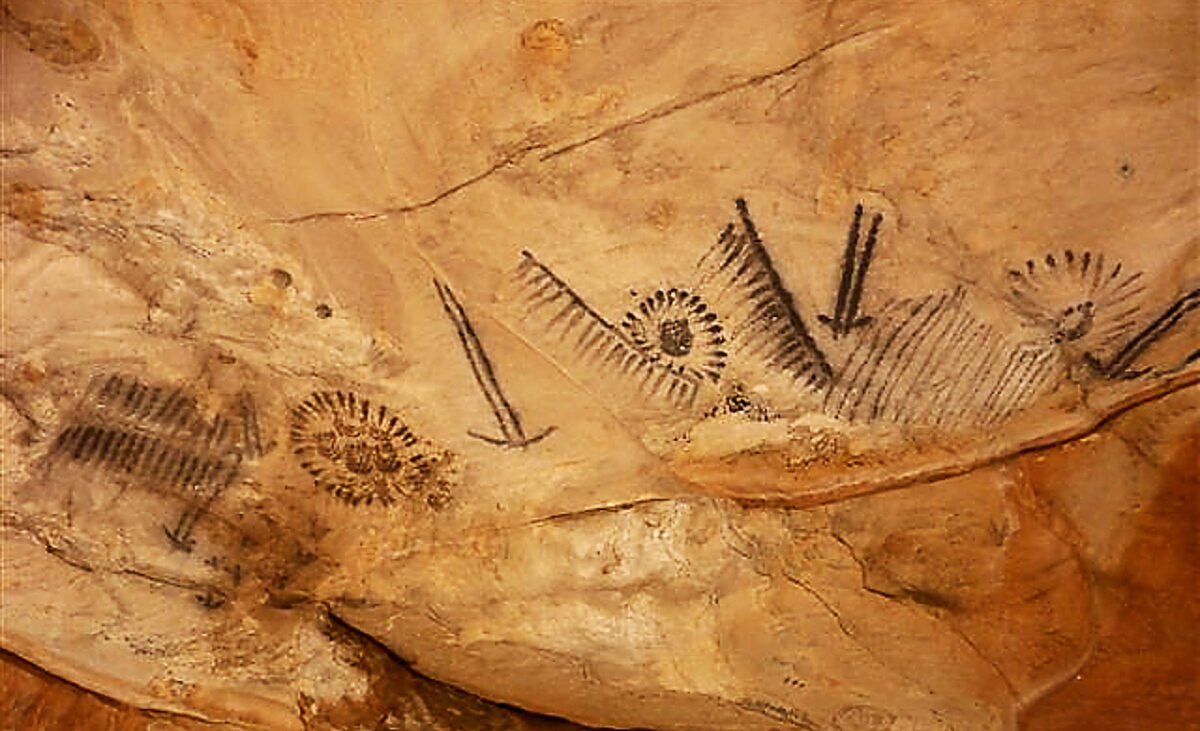
Charcoal drawings, Yourambula Caves, Flinders Ranges, South Australia
Source: M. A. Muir
Activity 2.4 – Analyse an image.
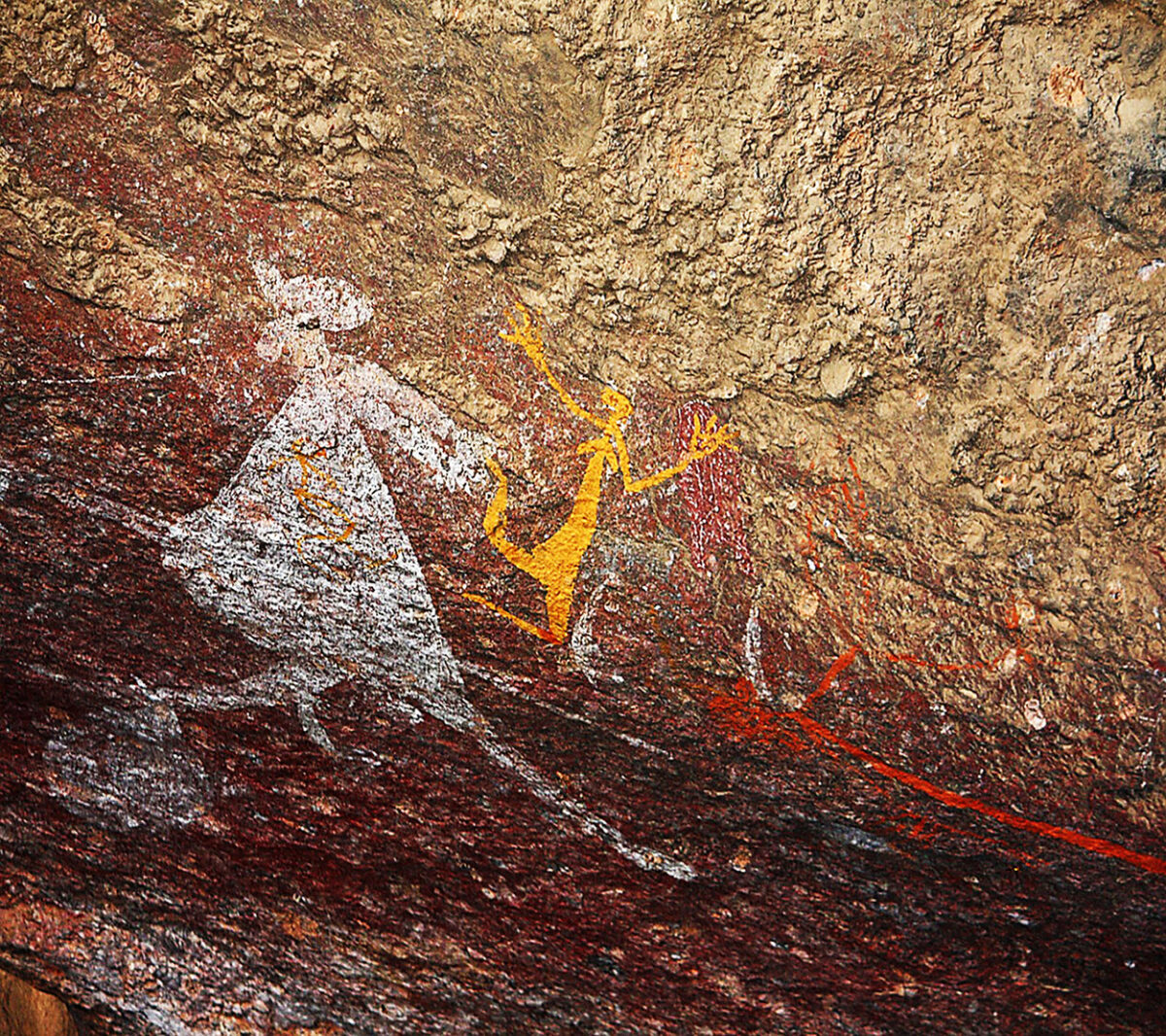
Rock art, Burrunggui (Nourlangie Rock), Kakadu NP, Northern Territory.
Source: M. M. Watts.
At Burrunggui (Nourlangie Rock), there is a 1.5km circular walk where it is possible to view a number of sheltered rocks containing many images that deal with Aboriginal mythology. The full details of the stories connected to these artworks are known only to certain Aboriginal people. However, some information is given to all visitors so that they can understand this rock art.
What images can you recognise in the photo above?
____________________________________________________________________
As far as you can tell, do you think this photo shows a painting or a drawing? Explain your answer.
___________________________________________________________________________
Activity 2.5: Words about pictographs
Every word here is used in Section 2. Unscramble each of the clue words. Copy the letters in the numbered cells to other cells with the same number.
Assessment
Download the assessment for this section.
Online assessment will be added in a future version.
Progress
Section not yet completed.