Indigenous Studies
Section 5: Rock Art in Indigenous Australian Culture
Activity 5.1 Background Rock Art in Indigenous Australian Culture
Art has always been an important part of Aboriginal life, connecting past and present, the people and the land, and the supernatural and reality. Unlike most other parts of the world, knowledge about rock-art remains strong among Australian groups, with stories about symbolism and meaning being passed down from generation to generation.
The great thing about Australian rock-art is that it is a continuing tradition and part of a living culture. Originally each site belonged to a particular group which had the right of access and the responsibility for looking after the paintings or engravings and for any necessary ceremonies. Many religious images were more than mere pictures. They represented the actual spiritual energy of the creative ancestors and when repainted or retouched in a ritual context their sacred power was released, ensuring that the seasons came at their proper time, plants and animals were in plentiful supply, and children were born.
In some parts of Australia, it is traditional practice for some Indigenous people to touch up the rock-art and renew the power of the images. For example, the Warlpiri and Pitjantjatjara people of the deserts still retouch their sacred images for specific ritual purposes.
In many parts of Australia, however, the history of the last 200 years has meant the loss of land and of traditional religious beliefs and practices. Nevertheless, the rock paintings and engravings found in these areas still have great symbolic significance to Aboriginal communities. The paintings demonstrate group ownership of sites and country and Indigenous Australian connections to their land. Even where images are no longer painted or repainted, they can still be very important to Indigenous people who know the stories and meanings associated with them.
For all Australians, rock art teaches about Indigenous people’s stories, history, relationships to land, social boundaries, belief systems and interaction with others. Figurative art that depicts people, for example, wearing headdresses, carrying dilly bags and using spears, teaches about dress and material culture, even though these items had never been found in archaeological excavations.
Dictionary practice: Match the word with its meaning.
What is meant by the term “living culture”?
Is all Indigenous Australian culture “living”? Explain your answer.
The following is an extract from http://www.creativespirits.info/aboriginalculture/arts/why-australias-aboriginal-rock-art-will-disappear Why Australia’s Aboriginal rock art will disappear.
“When Rachel Perkins scouted locations for her extraordinary series First Australians she had to abandon Bull Cave due to graffiti. ‘For instance, Bull Cave in Camden, down in Dharawal country. We went to film there because that was where the First Fleet’s cattle escaped and they wandered down south and they went into Dharawal country and the Dharawal people painted this extraordinary image of this massive bull on the cave wall. It is one of the first pieces of contact art, a really important site. We went down there to film and of course, someone has spray painted across it in red letters, …. so of course we can’t film there’.”
Should all Australians take more responsibility to care for Indigenous heritage? If you saw someone spray painting graffiti on an ancient Indigenous artwork, what would you do? Discuss these questions in your group. Write a summary of your discussion in the space below.
Activity 5.2 A story in the art of the Flinders Ranges, South Australia
Religious and ceremonial aspects of life, being so important, are the inspiration for much of Indigenous art and decoration that are an integral part of traditional life. Much of the painted and carved art can be divided simply into two broad categories or styles –
naturalistic or figurative – any person looking at the art is able to recognise what basic subject is being depicted. It looks basically natural or is a figure of the intended subject.
non-naturalistic or non-figurative – abstract styles and geometric pattern. For example, an arc shape might represent a man or woman sitting at their campfire, or it may represent a boomerang.
Adnyamathanha is the language and culture of the Flinders Ranges. Their painting sites are widely distributed in South Australia and are found in a variety of environments where suitable surfaces occur. Painted motifs include human-like shapes including feet and hands, circles, patterns and abstract designs. Some are touched up or repainted when the site is used again for rituals and ceremonies.
The rituals of the Adnyamathanha people were secret and exclusively male or female, although most involved both men and women. The Adnyamathanha people have given the general public sufficient information on abstract patterns on the rocks of Yourambula Caves that some general interpretations can be made.
The following table provides some information about the meaning of symbols on the rocks. (Original source: Yourambula Caves Information Board, Division of State Aboriginal Affairs, South Australia.)
“Painting sites are widely distributed in South Australia and are found in a variety of environments where suitable surfaces occur.” Where would you expect to find “suitable surfaces” for rock art? Explain your answer.
Are these symbols figurative or non-figurative?
Use the table above to work out what the symbols on this rock are referring to?

Sometimes the symbols are used together. For example, an animal track passing by a camp on its way to a water hole would look like this. (Original source: Yourambula Caves Information Board, Division of State Aboriginal Affairs, South Australia.)
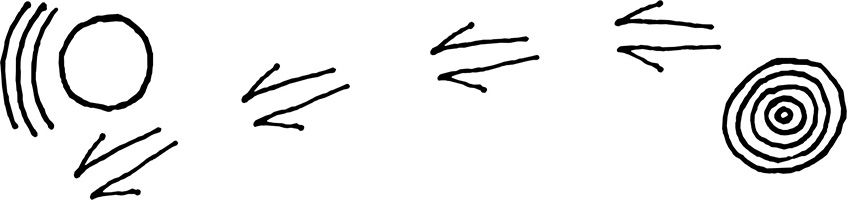
In the space below, use some of the symbols together to make up a description of another event.
Activity 5.3 – Word Search
Can you find the hidden words?
All of the words relate to Indigenous art practice. How many words do you know the meaning of? Have your partner test you.
Assessment
Download the assessment for this section.
Online assessment will be added in a future version.
Progress
Section not yet completed.