Indigenous Studies
Section 3: Rock Art – Stencils and Prints
Stencils were known in China as early as the 8th century, and Innuits in Baffin Island were making prints from stencils cut in sealskins before their contact with Western civilisation. In the 21st century, stencils are used for many purposes including fine paintings. Indeed, stencil artist Luke Cornish entered a portrait of a priest, Bob Maguire, into the 2012 Archibald Prize as part of a journey to have stencil art recognised as “real” art.
Long before stencils were used in other parts of the world, Indigenous Australians were producing stencil images. Stencil images are some of the oldest painted images known from the Australian continent. For example, in Arnhem Land, stencils are common in the earliest rock art. Stencils are found widely in rock art, usually of hands or arms, animal tracks, boomerangs, spear throwers or other tools such as stone axes. These cave and wall paintings can be found in almost all of Australia.
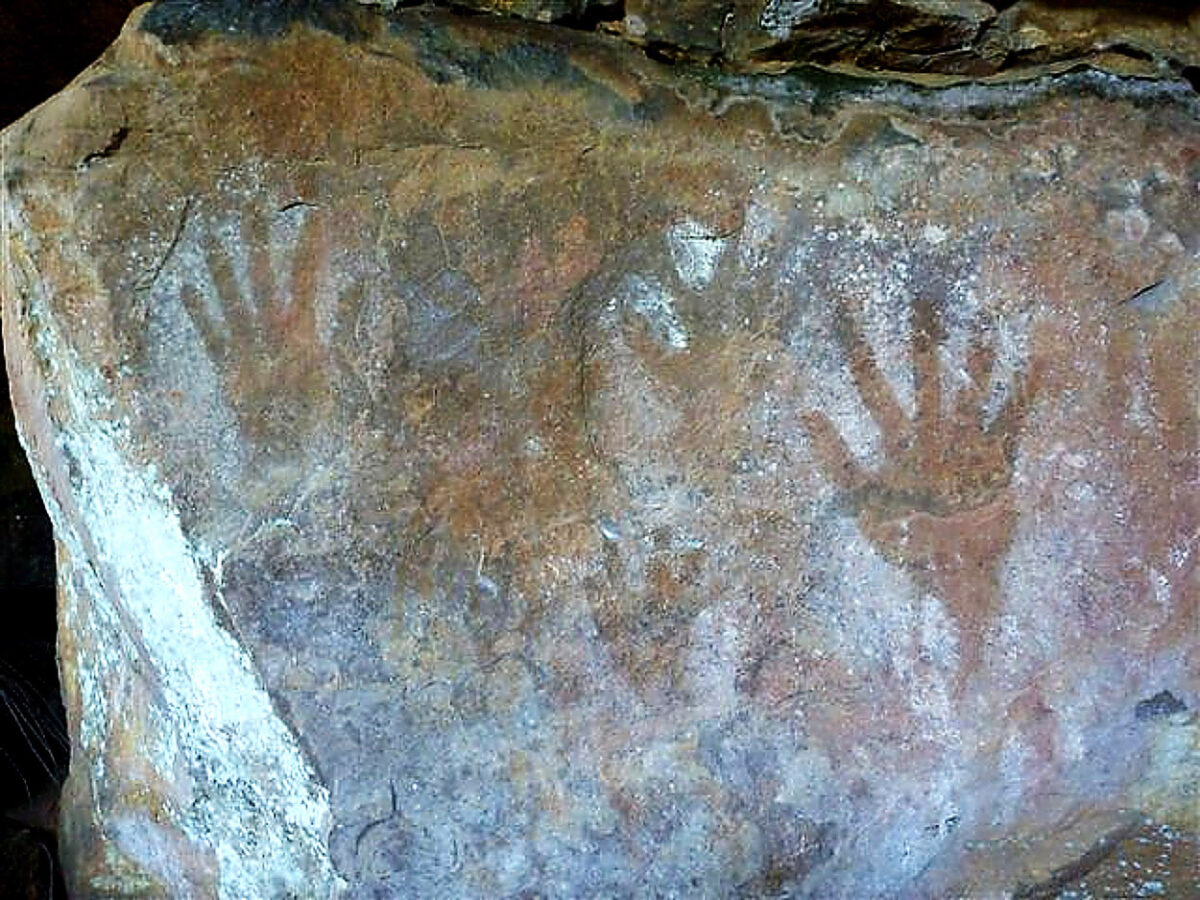
Location: Mitchell Falls, Kimberley, WA.
Source: M.A. Muir
Activity 3.1: Prepare a short report
Using your favourite Internet search engine, type in the word “stencil”. From the choices provided, select a site which will give you enough information to prepare a short report on one of the following topics:
Stencilling as an ancient art form.
Uses of stencilling in industry (e.g. silk screen printing, official use of stencilling).
Stencilling as a modern art form.
The Stencilling Technique
Stencilling is a technique for reproducing designs by passing ink or paint over a shape to get an outline, and over holes cut in cardboard or metal onto the surface to be decorated. A stencil is a thin sheet of material, such as paper, plastic, or metal, with letters or a design cut from it. The finished painting or design is also called a stencil.
However, paper, plastic and metal were not available in ancient times but people from many different places did use objects, including their own hands and arms, as “patterns” for their stencil art. The oldest evidence of this technique comes from the oldest continuous culture in the world – Indigenous Australian culture.
For example: Central Queensland’s Carnarvon Gorge is one of the most sacred places for the Bidjera and Darumbal people and figures strongly in Aboriginal Dreamtime stories. Carnarvon Gorge contains caves with spectacular Aboriginal stencil rock art, of which some dates back more than 18,000 years. In some caves there are stencil frescoes up to 137 metres long featuring hands, boomerangs and stone axes.
The ancient Indigenous Australian stencilling technique involves using a ground ochre suspended in water. To make a stencil of a handprint, the artist would pour this suspension into his mouth and then blow it all over the hand placed on the wall or ceiling surface. This technique creates a splatter painting around the outline of the hand which was placed on the wall.
Activity 3.2: Working with stencils
Ask your teacher to tell you which of the following activities you should attempt.
Making a splatter stencil.
Challenge: Can you work out a way to create a stencil of your own hand that would resemble the splatter stencils of Indigenous artists without putting any possibly poisonous paint pigments in your mouth?
Use the space below to draft out some ideas that you can share with your team.
As you work through this challenge, don’t forget to keep a journal of the problems that you faced and the solutions that you came up with.
Create a timeline using the Internet
Can you use the Internet and search engines effectively to find out
the locations and ages of rock art stencils across Australia?
the locations and ages of rock art stencils in other parts of the world such as Europe and South America?
Hints:
Use word combinations such as “location indigenous Australian stencil art” to start your search.
Make sure you can find each location on a map of Australia and, for the rest of the world, on a map of the world.
Use the space below to jot down your findings as you research.
Design and draw up a timeline in the space below that allows you to compare the ages of ancient Australian stencil art with that in other parts of the world. If you are not sure how to construct a timeline, there are many Internet sites to help you.
Hints:
Use a word combination such as “constructing timeline” to help you in your search for help.
Timelines are often used in history so history sites might be useful.
Use your findings to fill in the map of Australia below with the location and age of the stencil art that you found out about in part a.
[IMAGE: art_11.jpg|Map of Australia]
Prints
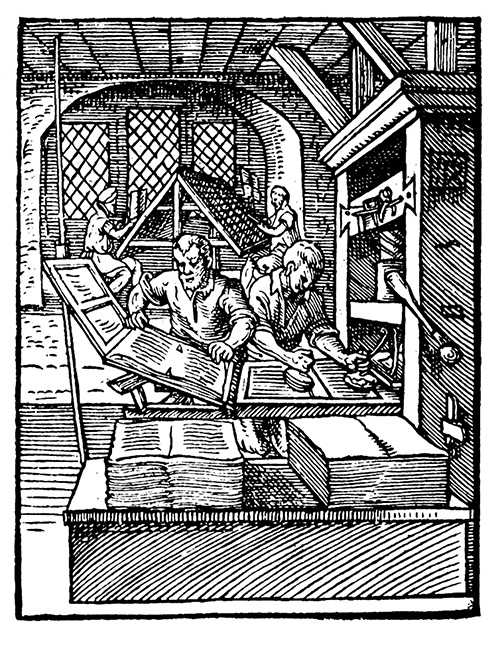
Printing involves the transfer of words or designs from solid objects on to paper or another medium such as cloth or clay. The picture that is produced is called a print. This process ensures that text or designs can be transferred many times with the original being kept indefinitely. This also allows for repeat prints of the same image to be made.
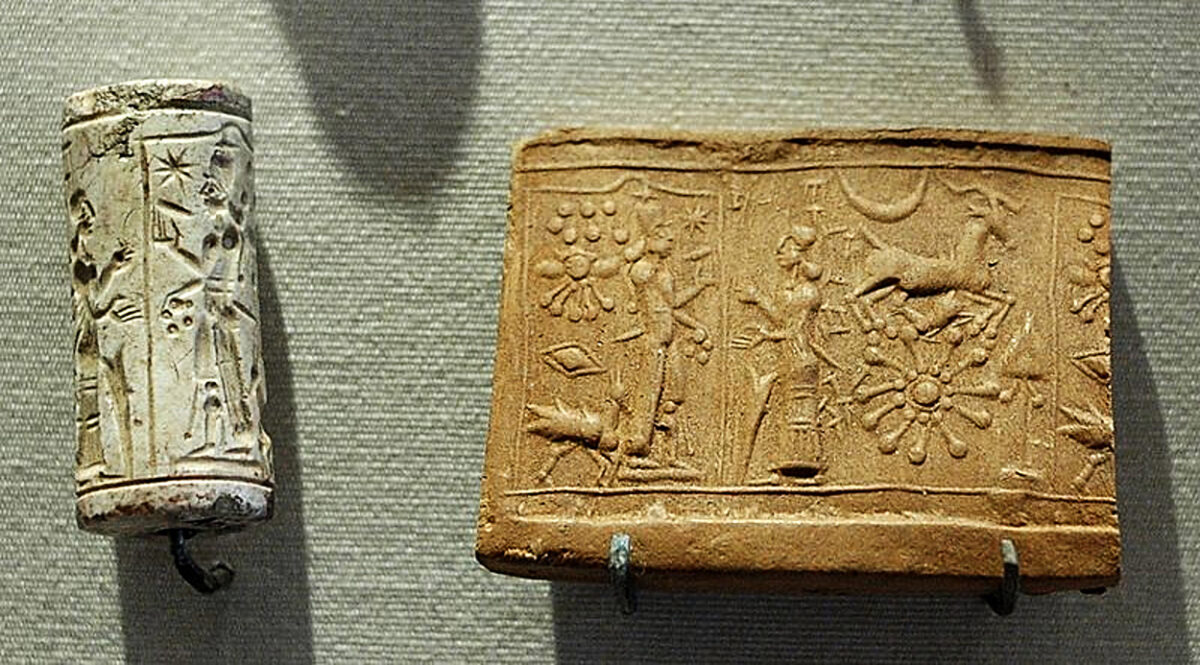
The history of printing started with the use of cylinder seals to roll an impression into clay. Such clay tablets go back to early Mesopotamian civilisation before 3000 B.C.E. (Mesopotamia was in what is now Iraq, in the very fertile area between the Tigris and Euphrates rivers.) Some works of art with complex and beautiful images from this time. In both China and Egypt, the use of small stamps for seals began not long after.
Later, woodblock printing was invented in China. This is a technique where the original design is carved into wood. It originated in China in antiquity as a method of printing on cloth and later on paper. The earliest lasting examples from China date to before 220 C.E.
Activity 3.3 – Modelling the printing process
Part 1: The easy model
Materials: You will need
Washed potato, cut in half
Surface for printing (fabric or a drawing paper)
Acrylic paints
paint brush
Plastic plate for mixing paint
Water container
Small knife or peeler (Safety note: be careful with the sharp edge)
Fine line felt tip marker.
Process:
Create a fairly simple design and draw freehand onto the cut side of one half of the potato (or trace around a cut out design) with the fine felt tip pen. Make your design simple as detail can be lost in a potato print. Remember that whatever is carved into the potato will appear in the reverse when printed.
Cut away the flesh of the potato from the background area of the design about 5mm into the potato.
Mix your acrylic paint and apply to the cut surface of the potato.
Apply the cut and painted potato upside down on to a test printing surface with a bit of pressure. Try a few practice prints to see if how it comes out. Adjust your design before you start on your final print run.
Allow the print to dry completely before handling.
Now repeat this process. Using all of the same materials as above, create and print your name.
Evaluation:
What do you think of the quality of your printed design?
Would you like to improve on this quality? If so, how could you achieve a better-quality printed design?
Part 2: The real challenge
Materials: You will need
Cylindrical vegetable such as a carrot or parsnip, or a large potato cut into a cylindrical shape
Small knife or peeler (Safety note: be careful with the sharp edge)
Fine line felt tip marker
Soft plasticine or clay
Using these materials, and a similar process to that above, design and create a cylinder seal. Use this seal to make an impression on the plasticine or clay.
Evaluation:
Comment on the difficulties you face in this task.
What do you think of the quality of your raised design?
Would you like to improve on this quality? If so, how could you achieve a better-quality product?
Meanwhile, back to Australia …
Long before printing events occurred in the rest of the world, Indigenous Australians, isolated from the rest of the world, had discovered that they could produce prints.
This type of rock art is rarer than stencils in Australia but is found across Australia from locations in Sydney to those in the Kimberley.
Handprints are made by dipping the palm of the hand in wet pigment and pressing it on to the rock surface. In some parts of Australia (such as western and north-western Arnhem Land) handprints are then covered with painted patterns after the print is made.
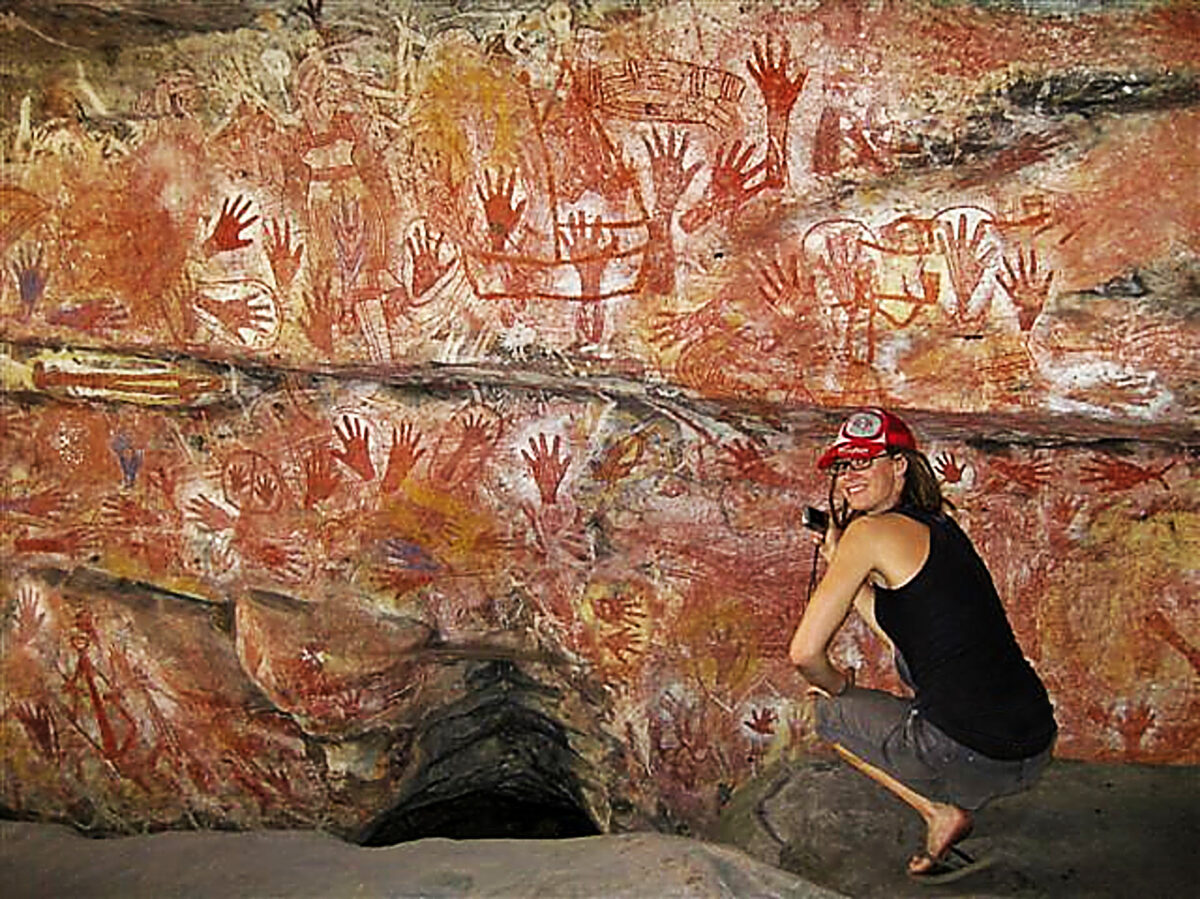
Rock art Arnhem Land NT. Source: M.A. Muir
The only prints in this photo are blue, a colour not normally seen in old rock art. Reckitt’s Blue is a very old product which was used before modern laundry liquids. It was used in a wash as a whitener, to help delay the yellowing effect that happens when cotton gets older. In the early days of white settlement, Europeans traded resources with the local Indigenous people. Reckitt’s Blue was one product that was traded and Indigenous people discovered it was good for rock art painting too.
Grass prints have also been identified in Australian rock art. These were produced by dipping grasses or reeds into wet pigment and throwing or flicking them on to the surface of the rock.
Activity 3.4 – Dictionary Practice
Some words have been underlined in the text on pages 21 and 23 that you need to check for their meaning. Before you complete that activity, go through the text again and underline any other words that you want to check too. Write these words in Table A and use a dictionary to find the meaning of that word that best suits the sentence in which it is used.
Table A: My list of new words
Table B: Matching meanings
Each item in Column 1 has its meaning in column 2 but they are not matching at the moment. Use your dictionary to match each word or pair of words with its meaning.
Demonstrate your understanding
Rewrite this sentence in different words to show that you understand what it is saying.
Activity 3.5 – Further Research
The information in this Section has used comparisons between Indigenous Australian art activities and those occurring in the rest of the world. At this stage, you may have realised that art in Australia is some of the oldest, indeed possibly the oldest, in the world.
This activity is to make sure that you know where the countries (past and present) are located across the rest of the world. Go back through the text in this Section and underline the names of countries and continents that are mentioned. Find the location of these places and write them in on the world map below.
Design and use a suitable legend or key under the map to identify why that place is important in your study of stencils and prints.

Activity 3.6 – A Sentence about Stencils and Prints
Assessment
Download the assessment for this section.
Online assessment will be added in a future version.
Progress
Section not yet completed.